Dialogue Group on Accountability for Ukraine
Coordinating efforts across international and national institutions to ensure accountability for international crimes committed in Ukraine.
About the Dialogue Group
The Dialogue Group on Accountability for Ukraine (hereinafter – Dialogue Group) is a collaborative initiative established to coordinate efforts among international, regional, and national institutions, in particular in support of national efforts to address accountability for international crimes committed in Ukraine. It serves as a non-decision-making platform designed to facilitate dialogue, information-sharing, and cooperation among stakeholders engaged in justice and accountability initiatives.
Mission
The Dialogue Group on Accountability for Ukraine was established following the Ukraine Accountability Conference held in The Hague on 14 July 2022. The conference resulted in a Political Declaration adopted by 45 States to ensure accountability for international crimes committed in Ukraine. The Dialogue Group promotes dialogue across diverse national and international accountability Stakeholders, identifying opportunities for enhanced coherence, synergies and effectiveness of support for Ukrainian actors on accountability for international crimes. This platform provides a centralized space to increase awareness of initiatives aimed at promoting accountability in relation to Ukraine, fostering collaboration between states, regional and international institutions, and civil society organizations. A website is developed to facilitate access to information about the Dialogue Group.
Mandate
The Dialogue Group operates as a non-decision-making platform that facilitates structured dialogue, information exchange, and strategic cooperation among key stakeholders. By fostering collaboration, we aim to avoid duplication of efforts and ensure a unified response to justice and accountability challenges in support of Ukrainian investigations, prosecution and sentencing at national level for international crimes committed in Ukraine.

Core objectives

Strengthening International Coordination
Facilitating structured discussions between governments, international organizations, and legal experts in order to enhance synergies and complementarity between the various initiatives in support of Ukrainian capacity for accountability for international crimes.

Enhancing Justice Efforts
Promoting best practices for documentation, evidence collection, and legal proceedings.

Supporting National and Civil Society Initiatives
Providing a platform for collaboration between investigative bodies, prosecution authorities, and civil society organizations.

Providing Transparency & Knowledge Sharing
Informing States and other stakeholders about the mandate and approach of the Dialogue Group, by making information publicly available on a website for the Dialogue Group.
Thematic areas
Harmonization of Ukrainian Legislation with International Standards
Legislative harmonization constitutes a core thematic priority of the Dialogue Group, supporting Ukraine’s efforts to align its domestic legal framework with international criminal law standards to enable effective, coherent, and sustainable prosecution of international crimes at the national level.
The alignment of national legislation with international criminal law standards remains central to the discussions within the Dialogue Group. Effective domestic accountability for international crimes requires a legal framework that is consistent with international obligations, internally coherent, and practically applicable to complex, large-scale investigations arising from an international armed conflict.
Within the Dialogue Group, legislative harmonization is approached as a strategic and systemic reform process, rather than a purely technical exercise focused on isolated amendments. Discussions within the Group emphasize that harmonization must ensure legal certainty, clarity of criminal definitions, and operational usability for investigators, prosecutors, and courts, while safeguarding fundamental principles of criminal law and criminal procedure.
A key institutional element of the legislative harmonization process is the Interagency Working Group (IWG) under the Prosecutor General’s Office of Ukraine. The IWG functions as a national coordination mechanism for legislative alignment following Ukraine’s ratification of the Rome Statute of the International Criminal Court. It brings together relevant state institutions, alongside civil society and international experts, to ensure a structured, inclusive, and coherent approach to reform. Within the Dialogue Group, the IWG is recognized as contributing to consistency across institutions and to reducing the risk of fragmented or contradictory legislative changes.
Dialogue Group exchanges on legislative harmonization focus on reform directions and systemic issues, rather than on the drafting of specific legal provisions. These exchanges address the need to strengthen criminal liability for international crimes, including war crimes and the crime of aggression, in line with international law, while ensuring coherence between substantive criminal law and criminal procedure. Particular attention is given to the interaction between legislative reform and prosecutorial practice, including evidentiary requirements and investigative mandates.
The Dialogue Group also addresses challenges related to transitional reforms. These include safeguarding against unintended legal gaps, avoiding decriminalization risks arising from the restructuring of existing provisions, and ensuring clarity regarding the temporal application of new legal norms. Legislative alignment is understood to require continuity of accountability for ongoing and future investigations, in full respect of the principle of legality and other fundamental safeguards of criminal law.
Across its work, the Dialogue Group emphasizes that legislative harmonization must balance strict adherence to international standards with the practical realities faced by national justice institutions. Legal frameworks that are formally compliant but operationally unworkable risk undermining accountability efforts, particularly in a context characterized by mass crimes, extensive evidentiary challenges, and significant institutional pressures.
Civil society organizations play an important role in legislative harmonization discussions facilitated by the Dialogue Group. Their engagement contributes to identifying legal gaps, assessing evidentiary implications, and highlighting implementation challenges. At the same time, the Dialogue Group promotes structured coordination among all actors involved to ensure coherence, complementarity, and effective use of expertise.
International partners participating in the Dialogue Group contribute comparative perspectives and technical experience drawn from other jurisdictions and international mechanisms. These exchanges support Ukraine’s reform efforts by providing reference points and lessons learned, while consistently reaffirming that legislative choices and decisions remain the prerogative of Ukrainian authorities.
Protection of victims' rights
Victims’ and witnesses’ rights constitute a core cross-cutting priority of the Dialogue Group, reflecting a commitment to survivor-centered, rights-based, and trauma-informed approaches in accountability processes for international crimes committed in Ukraine.
The support and protection of victims and witnesses remains central to the accountability framework addressed within the Dialogue Group. Across its meetings, the Group emphasizes that justice for international crimes is not limited to the prosecution of perpetrators, but encompasses the recognition of victims and witnesses as rights-holders entitled to dignity, protection, participation, and access to support throughout criminal proceedings.
Victims and witnesses in international crime proceedings face heightened risks, including intimidation, exposure to repeated and intrusive questioning, prolonged investigative and judicial timelines, and the psychological impact of recounting traumatic experiences. Dialogue Group discussions consistently underline that these risks require specific safeguards and coordinated institutional responses to prevent re-traumatization and secondary harm.
A trauma-informed approach is a recurring principle in Dialogue Group exchanges. This approach recognises the lasting psychological impact of violence and seeks to adapt investigative, prosecutorial, and judicial practices accordingly. It includes limiting unnecessary repetition of interviews, ensuring informed and voluntary participation, and promoting professional training for justice actors to engage with victims and witnesses in a manner that respects their psychological well-being.
Dialogue Group discussions further emphasize that effective victim and witness protection depends on coordination across institutions and disciplines. Prosecutorial authorities, law-enforcement bodies, psychosocial service providers, and civil society organizations all play complementary roles in ensuring that victims and witnesses receive timely legal, psychological, medical, and social assistance. Strengthening referral pathways and institutional cooperation is therefore identified as a continuing priority.
Victims’ participation in proceedings is addressed as both a right and a sensitive process. Dialogue Group exchanges highlight the need to balance meaningful participation with protective measures, ensuring that engagement with justice processes does not expose victims to further harm or insecurity. This balance is particularly important in cases involving mass crimes and collective victimisation.
Civil society organizations contribute to Dialogue Group discussions by sharing practical experience in victim support, documentation, and accompaniment. Their engagement assists in identifying gaps in protection frameworks and highlighting implementation challenges, while the Dialogue Group promotes structured coordination to ensure coherence and complementarity among all actors involved.
Crimes Against and Affecting Children (CAAC)
Crimes against and affecting children represent a distinct and critical thematic priority within the Dialogue Group, requiring child-sensitive legal, investigative, and support frameworks in accountability processes.
Children are among the most severely affected by the armed conflict in Ukraine and at the same time the most vulnerable group. Dialogue Group discussions consistently recognize that crimes such as unlawful deportation, forced displacement, exposure to violence, attacks on civilian infrastructure, and the broader consequences of armed hostilities raise specific legal, evidentiary, and protection challenges that differ from those affecting adults.
Across Dialogue Group meetings, crimes against and affecting children are addressed as requiring tailored accountability responses grounded in international legal standards, including international humanitarian law, international human rights law, and international norms on the protection of children in armed conflict. These discussions underline that children’s specific vulnerabilities necessitate adapted investigative and procedural approaches.
Child-sensitive justice is consistently emphasized as a core principle. This includes adapting interviewing techniques to the child’s age and developmental stage, minimising repeated questioning, ensuring the presence of appropriate safeguards and support persons, and integrating psychosocial expertise into investigative and prosecutorial processes. Dialogue Group discussions highlight that failure to apply such approaches risks both re-traumatization and evidentiary shortcomings.
Dialogue Group meetings also address challenges related to the legal classification and investigation of crimes affecting children. Participants emphasize the importance of coherent legal frameworks and consistent investigative standards to ensure that crimes involving children are properly identified, documented, and prosecuted. Fragmented approaches risk undermining accountability and the protection of children’s rights.
The Dialogue Group further recognises that accountability for crimes affecting children serves a broader protective and preventive function. Clear legal frameworks, child-sensitive procedures, and coordinated institutional responses contribute to deterrence and reaffirm international commitments to the protection of children during armed conflict.
Civil society organizations play a significant role in documenting crimes affecting children and providing specialised expertise on child protection and trauma. Their contributions to Dialogue Group discussions support a more comprehensive understanding of the challenges involved, while the Dialogue Group promotes structured coordination to ensure that such expertise complements, rather than substitutes, state accountability mechanisms.
Evidence collection /OSINT
Evidence collection, including the use of open-source intelligence (OSINT), constitutes a core cross-cutting priority of the Dialogue Group, supporting coordinated, lawful, and methodologically sound approaches to documenting and prosecuting international crimes committed in Ukraine.
The investigation and prosecution of international crimes committed in Ukraine take place in an evidentiary environment marked by ongoing hostilities, restricted access to crime scenes, large-scale displacement of victims and witnesses, and the transnational nature of offences. Within this context, the Dialogue Group addresses evidence collection as a continuing priority, with particular attention to the growing role of digital and open-source material in accountability processes.
Across Dialogue Group meetings, open-source intelligence encompassing publicly available digital material such as videos, photographs, satellite imagery, online communications, and other publicly accessible data is consistently recognised as an essential component of modern investigations. OSINT enables the documentation of crimes, the identification of patterns of conduct, geolocation and temporal analysis of incidents, and corroboration of witness testimony, particularly where direct access to locations or victims is limited or impossible.
Dialogue Group exchanges emphasise that OSINT functions as complementary evidence within a broader evidentiary framework. It does not replace traditional forms of evidence such as forensic material or witness testimony, but strengthens cases when used in conjunction with other evidentiary sources. National investigative practice discussed within the DG reflects an increasing reliance on open-source material, subject to judicial standards of admissibility and probative value.
Considerable attention within the Dialogue Group is devoted to the methodological safeguards governing the use of OSINT. Participants consistently underline that the evidentiary value of digital material depends on rigorous verification, corroboration, documentation, and preservation. This includes establishing authenticity, confirming time and location, maintaining traceability, and ensuring secure storage. Internationally recognised standards, including the Berkeley Protocol on Digital Open-Source Investigations, are referenced as guiding frameworks for ensuring consistency and reliability in practice.
Civil society organisations engaged in the systematic documentation and verification of open-source material contribute substantively to Dialogue Group discussions. Their input highlights both the value of OSINT in documenting international crimes and the legal and procedural challenges associated with its use, including the absence of a distinct procedural category for open-source material and inconsistencies in judicial treatment. These exchanges inform broader discussions on coherence, safeguards, and the role of expert verification, while respecting the boundaries of judicial independence and national legal frameworks.
From an institutional perspective, the Dialogue Group addresses the scale and complexity of digital evidence and the resulting need for enhanced analytical capacity, structured workflows, and coordination among national authorities, international partners, and civil society actors. Within this context, updates are shared on the development of an OSINT Concept Note and a proposal to establish an OSINT platform within the Prosecutor General’s Office, aimed at strengthening coordination and methodological alignment, without prejudging institutional or operational decisions.
Dialogue Group discussions further highlight the intersection between evidence collection and specific vulnerable victim groups, including children. Child-focused exchanges underscore the importance of adapting evidentiary approaches to minimise re-traumatisation, ensure appropriate safeguards, and preserve evidentiary integrity in cases involving child victims or witnesses, including where digital material plays a central role.
Dialogue Group workstreams

Assistance to Ukraine

Action by Regional and International Institutions

National Investigations

Civil Society Support for Accountability
Latest News & Updates
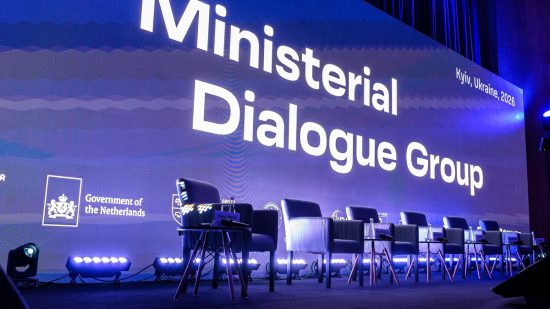
On 7 May 2026, the third annual Ministerial Meeting of the Dialogue Group on Accountability for Ukraine was held in Kyiv as part of the joint international event “United for Justice. Accountability for Crimes against Civilians”